E80 Group’s case study of automated truck loading at Barilla’s Pedrignano plant in Parma shows how a food manufacturer can extend warehouse automation to the loading bay. Published on 25 September 2026 and recently shared in the industry feed, the project is relevant to potato processors as a logistics example, rather than a new installation in the potato sector.
What the supplier describes
O E80 account describes laser-guided vehicles loading pallets into trailers, coordinated through its SM.I.LE80 software. The solution links the vehicle movements with the loading-bay environment, including trailer restraint and dock equipment from Rite-Hite.
The location is Pedrignano, not a separate Barilla factory. The supplier places the loading project within a wider automated operation. Its reference to more than 100 laser-guided vehicles concerns the broader site system and should not be read as the size of a new fleet dedicated solely to truck loading.
Dias úteis. Cancele a inscrição com um clique.
The case study describes the intended operating benefits, but it does not publish a comparable before-and-after loading-time series, an independently measured throughput gain or a complete investment payback calculation. Those missing measures limit the conclusions another manufacturer can draw about economics.
Why the loading bay matters to a processor
For a potato-processing business, finished goods leaving a warehouse are part of the same production flow as packaging and pallet handling. A mismatch between warehouse release, vehicle arrival and loading capacity can create a constraint even when individual pieces of equipment work as intended. This is the operational question illustrated by the Barilla example.
The transferable idea is coordination across the boundary between warehouse and trailer. It is not evidence that the same layout, vehicle type or software configuration will suit a frozen-fries factory, a crisp plant or a smaller packing business. Products, pallet formats, site layouts and transport arrangements need their own assessment.
A processor considering a similar approach would need to describe its actual loading tasks, variation between trailers, the handling of exceptions and the conditions under which people and automated vehicles share space. These are questions for a site-specific engineering and safety review, not installation instructions.
Evidence needed before an investment decision
A useful business case would start with a measured baseline: the time a vehicle spends at the site, the portion attributable to loading, the frequency of interruptions and the resources required to resolve them. It would then compare the proposed system over the same operating boundaries, including maintenance and periods when equipment is unavailable.
The cost discussion should include integration, staff training and arrangements for abnormal loads or incompatible trailers. A demonstration that a robot can enter a trailer answers one technical question; it does not by itself explain the effect on the complete dispatch operation.
For potato-sector readers, the Barilla project is therefore a concrete example to examine during logistics planning. The next step is to request operational evidence relevant to the intended application and compare it with the plant’s own constraints. Supplier descriptions can identify a possible solution; the investment decision still needs a documented local case.
O que isso significa para as fazendas e o mercado
- The reported installation is at Barilla’s Pedrignano plant; it is a food-logistics case study, not a potato-factory announcement.
- The wider fleet figure is not the number of vehicles assigned exclusively to the new loading task.
- Assess loading time, exceptions, integration and total operating cost before drawing conclusions about payback.
Fontes
- E80 Group — Barilla automated truck loading, 25 September 2026
- Trans.info — independent coverage of the project
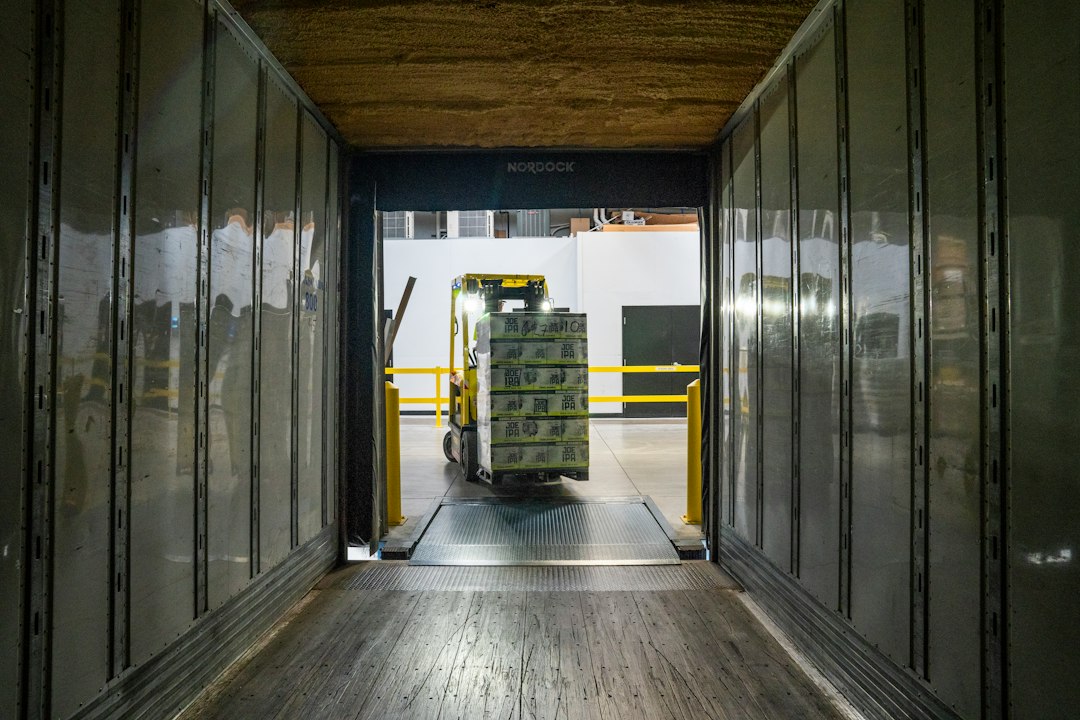
A forklift loading pallets at a warehouse; illustrative stock photograph, not the Barilla installation or an E80 vehicle. Photo: Elevate / Unsplash.